
Export "Finished Goods Outgoing Inspection Defect Summary" to Excel with Java (Styled & Formatted Reports)
Styled & Formatted ReportsScene 0078
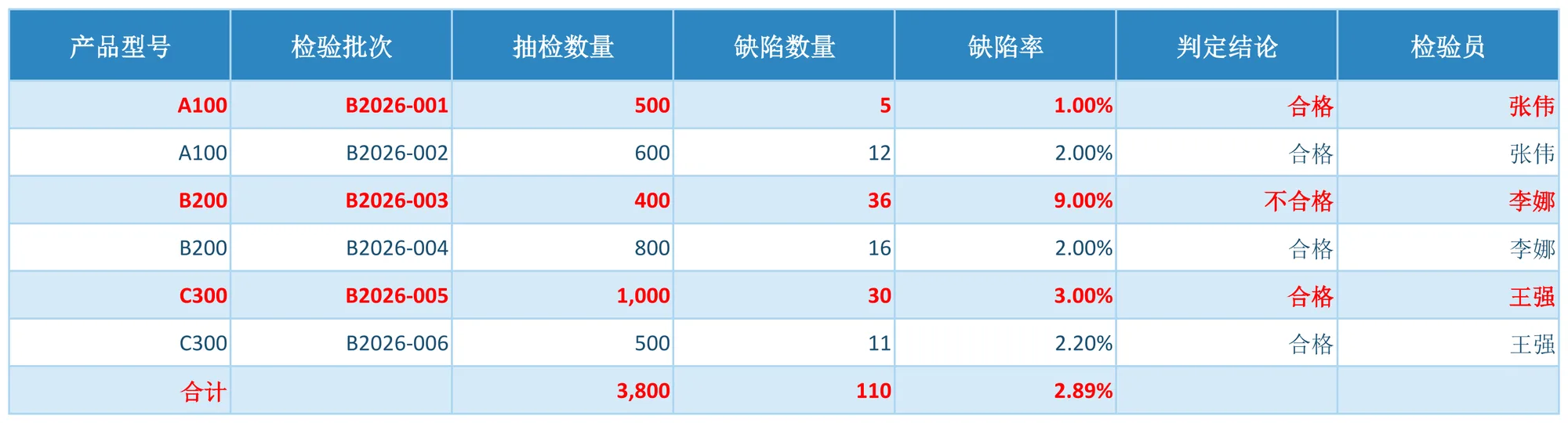
Registers sampled quantity and defect quantity by inspection batch, computing Defect Rate = Defect Quantity / Sampled Quantity per row, with the last row summarizing total sampled quantity, total defect quantity and the overall defect rate; batches exceeding the defect-rate limit are marked in red. Implemented declaratively in pure XML — no Java business code required.
About this demo
This demo exports the "Finished Goods Outgoing Inspection Defect Summary" workbook: 1 data sheet(s); MAPPING over 7 columns (产品型号, 检验批次, 抽检数量, 缺陷数量, 缺陷率, 判定结论, 检验员), 11 formula(s), 1 style rule(s). On the Java side it builds 7 data rows and calls exportFinishedGoodsDefect() once — everything else is driven by the config.
It belongs to the "Styled & Formatted Reports" group: STYLE and conditional formatting: themed headers, zebra striping, highlighted total rows and threshold-based colouring of abnormal cells.
What you can copy from this page
- The complete Java test class (66 lines, runnable as-is)
- The complete XML config (32 lines: mapping, formulas, styles, charts and every other rule)
- The exported xlsx file (real output, comparable with the preview above)
Related searches: Java export Excel styles, Java Excel header style zebra rows, Apache POI CellStyle export, Java Excel conditional formatting, export Finished Goods Outgoing Inspection Defect Summary to Excel with Java
Output specs
- Scene no.
- 0078
- Group
- Styled & Formatted Reports
- Config lines
- 32
- Source lines
- 66
Java source · Style0078FinishedGoodsDefectDemo.java
This is the complete test class that produced the Excel file above — copy it and run as-is. Java only builds the data rows; all statistics and styling live in the XML config.
package com.github.paohaijiao.biz.style;

import com.github.paohaijiao.statement.JQuickRow;
import com.github.paohaijiao.xml.ex.JQuickExcelExportXmlParseFactory;
import com.github.paohaijiao.xml.factory.JQuickFactory;
import com.github.paohaijiao.xml.factory.JQuickXmlFactory;
import com.github.paohaijiao.xml.handler.JQuickParseHandler;
import org.junit.Test;

import java.io.File;
import java.io.FileOutputStream;
import java.io.OutputStream;
import java.util.ArrayList;
import java.util.List;

public class Style0078FinishedGoodsDefectDemo {

    private static final String XML = "jquick/biz/style/0078_style_finished-goods-defect.xml";

    /** 导出:纯 XML 完成逐行缺陷率、合计、整体缺陷率与超标标红。 */
    @Test
    public void exportFinishedGoodsDefect() throws Exception {
        List<JQuickRow> rows = new ArrayList<>();
        // e 留空,由 FORMULAS 计算
        rows.add(batch("A100", "B2026-001", 500, 5, "合格", "张伟"));
        rows.add(batch("A100", "B2026-002", 600, 12, "合格", "张伟"));
        rows.add(batch("B200", "B2026-003", 400, 36, "不合格", "李娜"));
        rows.add(batch("B200", "B2026-004", 800, 16, "合格", "李娜"));
        rows.add(batch("C300", "B2026-005", 1000, 30, "合格", "王强"));
        rows.add(batch("C300", "B2026-006", 500, 11, "合格", "王强"));
        // 合计占位行:各列合计与整体缺陷率留给 FORMULAS
        JQuickRow total = new JQuickRow();
        total.put("a", "合计");
        total.put("b", null);
        total.put("c", null);
        total.put("d", null);
        total.put("e", null);
        total.put("f", null);
        total.put("g", null);
        rows.add(total);

        File out = new File("D:/test/excel/biz/style/0078_style_finished-goods-defect.xlsx");
        try (OutputStream os = new FileOutputStream(out)) {
            JQuickParseHandler parser = new JQuickExcelExportXmlParseFactory("skyBlue", rows, os);
            JQuickFactory factory = new JQuickXmlFactory(parser, XML);
            Style0078FinishedGoodsDefectService service = factory.createApi(Style0078FinishedGoodsDefectService.class);
            service.exportFinishedGoodsDefect("field", "value");
        }

    }

    /** 构造一个检验批次(a=型号,b=批次,c=抽检数量,d=缺陷数量,e 留空,f=判定,g=检验员)。 */
    private static JQuickRow batch(String model, String batchNo, double inspectionQuantity,
                                   double defectQuantity, String verdict, String inspector) {
        JQuickRow row = new JQuickRow();
        row.put("a", model);
        row.put("b", batchNo);
        row.put("c", inspectionQuantity);
        row.put("d", defectQuantity);
        row.put("e", null);
        row.put("f", verdict);
        row.put("g", inspector);
        return row;
    }
}
Minimal invocation (4 lines)
The core is these four lines: hand the rows to the parser, the parser to the factory, get a typed Service and call it. Copy them straight into your project.
// rows 由业务代码构造(List<JQuickRow>),os 为输出流,见下方完整源码
JQuickParseHandler parser = new JQuickExcelExportXmlParseFactory("skyBlue", rows, os);
JQuickFactory factory = new JQuickXmlFactory(parser, XML);
Style0078FinishedGoodsDefectService service = factory.createApi(Style0078FinishedGoodsDefectService.class);
XML config · 0078_style_finished-goods-defect.xml
Formats (FORMAT), formulas (FORMULAS) and styles (STYLE) are all declared in this XML, fully decoupled from the Java code. The full config is below — copy it as-is.
<?xml version="1.0" encoding="UTF-8"?>
<!DOCTYPE excels PUBLIC "-//PAOHAIJIAO//DTD API EXCEL 1.0//EN"
        "classpath:paohaijiao/dtd/Jquick-excel.dtd">
<excels namespace="com.github.paohaijiao.biz.style.Style0078FinishedGoodsDefectService">

    <!-- 导出:成品出厂检验缺陷统计表 -->
    <excel name="exportFinishedGoodsDefect" returnClass="void">
        <![CDATA[
            EXPORT WITH SHEET="成品出厂检验缺陷统计表", HEADER=true,
                MAPPING={"a":"产品型号","b":"检验批次","c":"抽检数量","d":"缺陷数量","e":"缺陷率","f":"判定结论","g":"检验员"},
                FORMAT={"c":"#,##0","d":"#,##0","e":"0.00%"},
                FORMULAS={
                    E2:'D2/C2',E3:'D3/C3',E4:'D4/C4',E5:'D5/C5',E6:'D6/C6',E7:'D7/C7',
                    C8:'SUM(C2:C7)',D8:'SUM(D2:D7)',E8:'D8/C8'
                },
                STYLE={
                    ROW 8:{bold:true,fillPattern:solid_foreground,fillForegroundColor:lightYellow,alignment:right,verticalAlignment:center},
                    E4:{color:red,bold:true}
                }
        ]]>
    </excel>

    <!-- 导入解析:读取导出的成品出厂检验缺陷统计表 -->
    <excel name="importFinishedGoodsDefect" returnClass="java.util.List">
        <![CDATA[
            IMPORT WITH SHEET="成品出厂检验缺陷统计表", HEADER=true,
                MAPPING={"产品型号":"productModel","检验批次":"inspectionBatch","抽检数量":"inspectionQuantity","缺陷数量":"defectQuantity","缺陷率":"defectRate","判定结论":"verdict","检验员":"inspector"}
        ]]>
    </excel>

</excels>
More demos in this group
The Excel file, preview image, XML config and source code on this page were all produced by a real JQuick-Excel run and are free to copy into your own project.