
Export "Incoming Inspection Nonconformance Record" to Excel with Java (Styled & Formatted Reports)
Styled & Formatted ReportsScene 0072
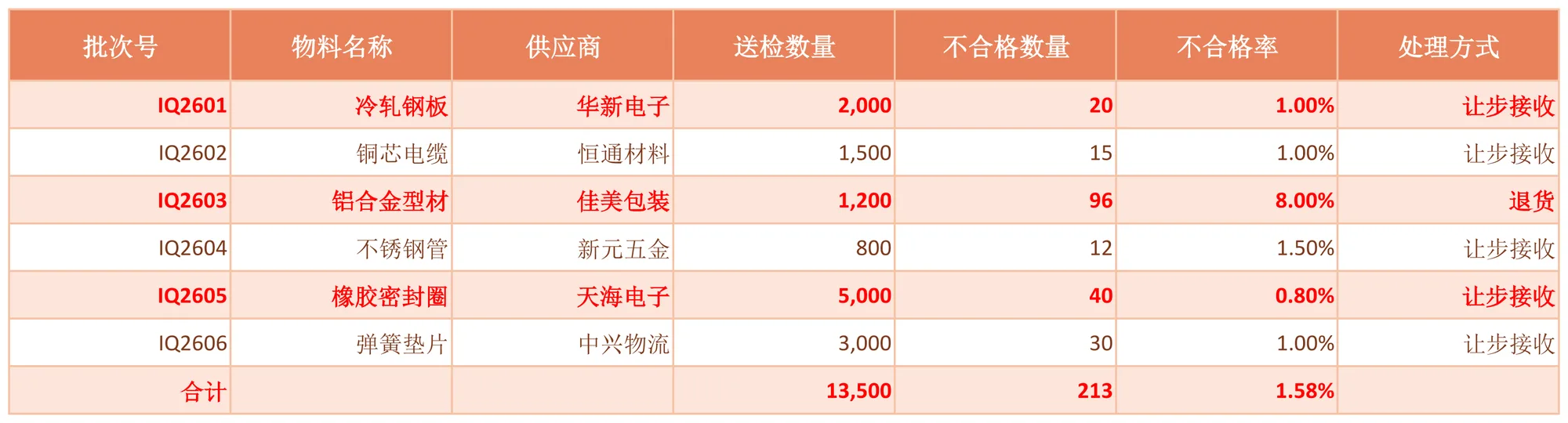
Registers submitted quantity and nonconforming quantity by incoming batch, computing Nonconformance Rate = Nonconforming Quantity / Submitted Quantity per row, with the last row giving the summary quantity and overall nonconformance rate; batches exceeding the nonconformance-rate limit are marked in red. Implemented declaratively in pure XML — no Java business code required.
About this demo
This demo exports the "Incoming Inspection Nonconformance Record" workbook: 1 data sheet(s); MAPPING over 7 columns (批次号, 物料名称, 供应商, 送检数量, 不合格数量, 不合格率, 处理方式), 11 formula(s), 1 style rule(s). On the Java side it builds 7 data rows and calls exportIncomingInspectionDefect() once — everything else is driven by the config.
It belongs to the "Styled & Formatted Reports" group: STYLE and conditional formatting: themed headers, zebra striping, highlighted total rows and threshold-based colouring of abnormal cells.
What you can copy from this page
- The complete Java test class (66 lines, runnable as-is)
- The complete XML config (32 lines: mapping, formulas, styles, charts and every other rule)
- The exported xlsx file (real output, comparable with the preview above)
Related searches: Java export Excel styles, Java Excel header style zebra rows, Apache POI CellStyle export, Java Excel conditional formatting, export Incoming Inspection Nonconformance Record to Excel with Java
Output specs
- Scene no.
- 0072
- Group
- Styled & Formatted Reports
- Config lines
- 32
- Source lines
- 66
Java source · Style0072IncomingInspectionDefectDemo.java
This is the complete test class that produced the Excel file above — copy it and run as-is. Java only builds the data rows; all statistics and styling live in the XML config.
package com.github.paohaijiao.biz.style;

import com.github.paohaijiao.statement.JQuickRow;
import com.github.paohaijiao.xml.ex.JQuickExcelExportXmlParseFactory;
import com.github.paohaijiao.xml.factory.JQuickFactory;
import com.github.paohaijiao.xml.factory.JQuickXmlFactory;
import com.github.paohaijiao.xml.handler.JQuickParseHandler;
import org.junit.Test;

import java.io.File;
import java.io.FileOutputStream;
import java.io.OutputStream;
import java.util.ArrayList;
import java.util.List;

public class Style0072IncomingInspectionDefectDemo {

    private static final String XML = "jquick/biz/style/0072_style_incoming-inspection-defect.xml";

    /** 导出:纯 XML 完成不合格率、数量汇总与超标标红。 */
    @Test
    public void exportIncomingInspectionDefect() throws Exception {
        List<JQuickRow> rows = new ArrayList<>();
        // f=不合格率 留空,由 FORMULAS 计算
        rows.add(batch("IQ2601", "冷轧钢板", "华新电子", 2000, 20, "让步接收"));
        rows.add(batch("IQ2602", "铜芯电缆", "恒通材料", 1500, 15, "让步接收"));
        rows.add(batch("IQ2603", "铝合金型材", "佳美包装", 1200, 96, "退货"));
        rows.add(batch("IQ2604", "不锈钢管", "新元五金", 800, 12, "让步接收"));
        rows.add(batch("IQ2605", "橡胶密封圈", "天海电子", 5000, 40, "让步接收"));
        rows.add(batch("IQ2606", "弹簧垫片", "中兴物流", 3000, 30, "让步接收"));
        // 合计占位行:数量合计与整体不合格率留给 FORMULAS
        JQuickRow total = new JQuickRow();
        total.put("a", "合计");
        total.put("b", null);
        total.put("c", null);
        total.put("d", null);
        total.put("e", null);
        total.put("f", null);
        total.put("g", null);
        rows.add(total);

        File out = new File("D:/test/excel/biz/style/0072_style_incoming-inspection-defect.xlsx");
        try (OutputStream os = new FileOutputStream(out)) {
            JQuickParseHandler parser = new JQuickExcelExportXmlParseFactory("peach", rows, os);
            JQuickFactory factory = new JQuickXmlFactory(parser, XML);
            Style0072IncomingInspectionDefectService service = factory.createApi(Style0072IncomingInspectionDefectService.class);
            service.exportIncomingInspectionDefect("field", "value");
        }

    }

    /** 构造一条来料检验(a=批次号,b=物料名称,c=供应商,d=送检数量,e=不合格数量,f=不合格率,g=处理方式)。 */
    private static JQuickRow batch(String batchNo, String materialName, String supplier,
                                   int inspectionQty, int defectQty, String disposal) {
        JQuickRow row = new JQuickRow();
        row.put("a", batchNo);
        row.put("b", materialName);
        row.put("c", supplier);
        row.put("d", inspectionQty);
        row.put("e", defectQty);
        row.put("f", null);
        row.put("g", disposal);
        return row;
    }
}
Minimal invocation (4 lines)
The core is these four lines: hand the rows to the parser, the parser to the factory, get a typed Service and call it. Copy them straight into your project.
// rows 由业务代码构造(List<JQuickRow>),os 为输出流,见下方完整源码
JQuickParseHandler parser = new JQuickExcelExportXmlParseFactory("peach", rows, os);
JQuickFactory factory = new JQuickXmlFactory(parser, XML);
Style0072IncomingInspectionDefectService service = factory.createApi(Style0072IncomingInspectionDefectService.class);
XML config · 0072_style_incoming-inspection-defect.xml
Formats (FORMAT), formulas (FORMULAS) and styles (STYLE) are all declared in this XML, fully decoupled from the Java code. The full config is below — copy it as-is.
<?xml version="1.0" encoding="UTF-8"?>
<!DOCTYPE excels PUBLIC "-//PAOHAIJIAO//DTD API EXCEL 1.0//EN"
        "classpath:paohaijiao/dtd/Jquick-excel.dtd">
<excels namespace="com.github.paohaijiao.biz.style.Style0072IncomingInspectionDefectService">

    <!-- 导出:来料检验不合格记录表 -->
    <excel name="exportIncomingInspectionDefect" returnClass="void">
        <![CDATA[
            EXPORT WITH SHEET="来料检验不合格记录表", HEADER=true,
                MAPPING={"a":"批次号","b":"物料名称","c":"供应商","d":"送检数量","e":"不合格数量","f":"不合格率","g":"处理方式"},
                FORMAT={"d":"#,##0","e":"#,##0","f":"0.00%"},
                FORMULAS={
                    F2:'E2/D2',F3:'E3/D3',F4:'E4/D4',F5:'E5/D5',F6:'E6/D6',F7:'E7/D7',
                    D8:'SUM(D2:D7)',E8:'SUM(E2:E7)',F8:'E8/D8'
                },
                STYLE={
                    ROW 8:{bold:true,fillPattern:solid_foreground,fillForegroundColor:lightYellow,alignment:right,verticalAlignment:center},
                    F4:{color:red,bold:true}
                }
        ]]>
    </excel>

    <!-- 导入解析:读取导出的来料检验记录 -->
    <excel name="importIncomingInspectionDefect" returnClass="java.util.List">
        <![CDATA[
            IMPORT WITH SHEET="来料检验不合格记录表", HEADER=true,
                MAPPING={"批次号":"batchNo","物料名称":"materialName","供应商":"supplier","送检数量":"inspectionQty","不合格数量":"defectQty","不合格率":"defectRate","处理方式":"disposal"}
        ]]>
    </excel>

</excels>
More demos in this group
The Excel file, preview image, XML config and source code on this page were all produced by a real JQuick-Excel run and are free to copy into your own project.