
Export "Employee Master Data Code Value Transformation" to Excel with Java (Data Transformation)
Data TransformationScene 0101
In the employee master data, gender / department / status are stored as internal code values and are converted to Chinese via a dictionary on export. Implemented declaratively in pure XML — no Java business code required.
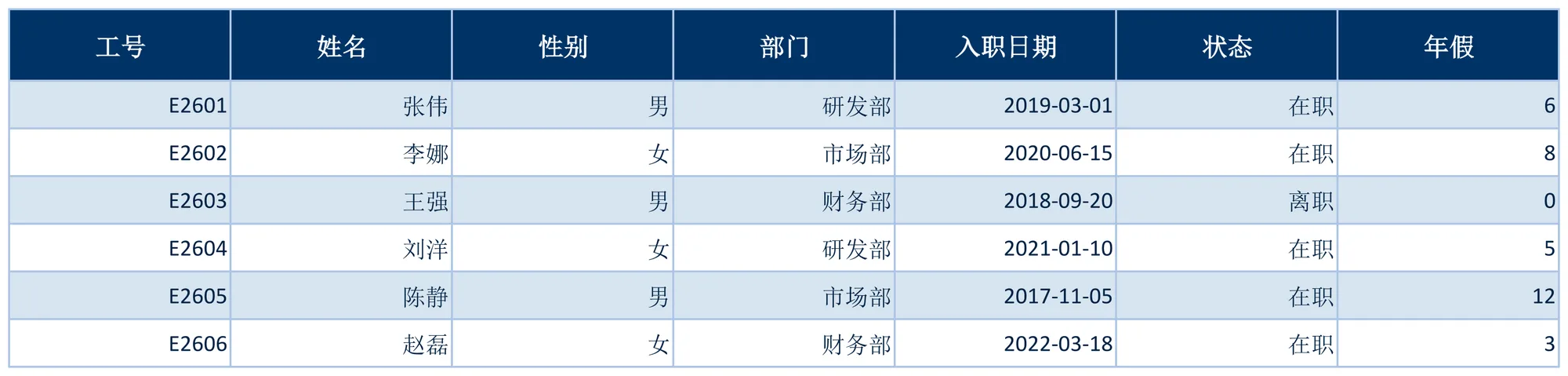
About this demo
This demo exports the "Employee Master Data Code Value Transformation" workbook: 1 data sheet(s); MAPPING over 7 columns (工号, 姓名, 性别, 部门, 入职日期, 状态, 年假). On the Java side it builds 6 data rows and calls exportEmployeeMasterData() once — everything else is driven by the config.
It belongs to the "Data Transformation" group: TRANSFORM field conversion: code-value mapping, date formatting and masking applied during export.
What you can copy from this page
- The complete Java test class (73 lines, runnable as-is)
- The complete XML config (26 lines: mapping, formulas, styles, charts and every other rule)
- The exported xlsx file (real output, comparable with the preview above)
Related searches: Java export Excel data transform, Java Excel code value mapping, Java Excel date formatting export, export Employee Master Data Code Value Transformation to Excel with Java
Output specs
- Scene no.
- 0101
- Group
- Data Transformation
- Config lines
- 26
- Source lines
- 73
Java source · Transform0101EmployeeMasterDataDemo.java
This is the complete test class that produced the Excel file above — copy it and run as-is. Java only builds the data rows; all statistics and styling live in the XML config.
package com.github.paohaijiao.biz.transform;

import com.github.paohaijiao.param.JContext;
import com.github.paohaijiao.statement.JQuickRow;
import com.github.paohaijiao.xml.ex.JQuickExcelExportXmlParseFactory;
import com.github.paohaijiao.xml.factory.JQuickFactory;
import com.github.paohaijiao.xml.factory.JQuickXmlFactory;
import com.github.paohaijiao.xml.handler.JQuickParseHandler;
import org.junit.Test;

import java.io.File;
import java.io.FileOutputStream;
import java.io.OutputStream;
import java.text.SimpleDateFormat;
import java.util.ArrayList;
import java.util.HashMap;
import java.util.List;
import java.util.Map;

public class Transform0101EmployeeMasterDataDemo {

    private static final String XML = "jquick/biz/transform/0101_transform_employee-master-data.xml";

    /** 导出:内部码值经 TRANSFORM 字典转为中文,回读校验性别 / 部门 / 状态三列。 */
    @Test
    public void exportEmployeeMasterData() throws Exception {
        JContext ctx = new JContext();
        Map<String, Object> dict = new HashMap<>();
        // 性别码值
        dict.put("1", "男");
        dict.put("2", "女");
        // 部门码值
        dict.put("RD", "研发部");
        dict.put("MK", "市场部");
        dict.put("FN", "财务部");
        // 状态码值
        dict.put("A", "在职");
        dict.put("B", "离职");
        ctx.put("dict", dict);

        List<JQuickRow> rows = new ArrayList<>();
        rows.add(employee("E2601", "张伟", "1", "RD", "2019-03-01", "A", 6));
        rows.add(employee("E2602", "李娜", "2", "MK", "2020-06-15", "A", 8));
        rows.add(employee("E2603", "王强", "1", "FN", "2018-09-20", "B", 0));
        rows.add(employee("E2604", "刘洋", "2", "RD", "2021-01-10", "A", 5));
        rows.add(employee("E2605", "陈静", "1", "MK", "2017-11-05", "A", 12));
        rows.add(employee("E2606", "赵磊", "2", "FN", "2022-03-18", "A", 3));

        File out = new File("D:/test/excel/biz/transform/0101_transform_employee-master-data.xlsx");
        try (OutputStream os = new FileOutputStream(out)) {
            JQuickParseHandler parser = new JQuickExcelExportXmlParseFactory("navyBlue", ctx, rows, os);
            JQuickFactory factory = new JQuickXmlFactory(parser, XML);
            Transform0101EmployeeMasterDataService service = factory.createApi(Transform0101EmployeeMasterDataService.class);
            service.exportEmployeeMasterData("field", "value");
        }

    }

    /** 构造一条员工主数据(c/d/f 为内部码值,导出时经字典转中文;e 为日期对象走 FORMAT)。 */
    private static JQuickRow employee(String no, String name, String sex, String dept,
                                      String hireDate, String status, int leaveDays) throws Exception {
        JQuickRow row = new JQuickRow();
        row.put("a", no);
        row.put("b", name);
        row.put("c", sex);
        row.put("d", dept);
        row.put("e", new SimpleDateFormat("yyyy-MM-dd").parse(hireDate));
        row.put("f", status);
        row.put("g", leaveDays);
        return row;
    }
}
Minimal invocation (4 lines)
The core is these four lines: hand the rows to the parser, the parser to the factory, get a typed Service and call it. Copy them straight into your project.
// rows 由业务代码构造(List<JQuickRow>),os 为输出流,见下方完整源码
JQuickParseHandler parser = new JQuickExcelExportXmlParseFactory("navyBlue", ctx, rows, os);
JQuickFactory factory = new JQuickXmlFactory(parser, XML);
Transform0101EmployeeMasterDataService service = factory.createApi(Transform0101EmployeeMasterDataService.class);
XML config · 0101_transform_employee-master-data.xml
Formats (FORMAT), formulas (FORMULAS) and styles (STYLE) are all declared in this XML, fully decoupled from the Java code. The full config is below — copy it as-is.
<?xml version="1.0" encoding="UTF-8"?>
<!DOCTYPE excels PUBLIC "-//PAOHAIJIAO//DTD API EXCEL 1.0//EN"
        "classpath:paohaijiao/dtd/Jquick-excel.dtd">
<excels namespace="com.github.paohaijiao.biz.transform.Transform0101EmployeeMasterDataService">

    <!-- 导出:内部码值 -> 中文 -->
    <excel name="exportEmployeeMasterData" returnClass="void">
        <![CDATA[
            EXPORT WITH SHEET="员工主数据", HEADER=true,
                MAPPING={"a":"工号","b":"姓名","c":"性别","d":"部门","e":"入职日期","f":"状态","g":"年假"},
                FORMAT={"e":"yyyy-MM-dd","g":"0"},
                TRANSFORM={"c":trans(${dict},${c}),"d":trans(${dict},${d}),"f":trans(${dict},${f})}
        ]]>
    </excel>

    <!-- 导入解析:日期归一,其余字段按表头映射 -->
    <excel name="importEmployeeMasterData" returnClass="java.util.List">
        <![CDATA[
            IMPORT WITH SHEET="员工主数据", HEADER=true,
                MAPPING={"工号":"employeeNo","姓名":"name","性别":"sex","部门":"dept","入职日期":"hireDate","状态":"status","年假":"leaveDays"},
                TRANSFORM={"hireDate":dateFormat(${hireDate},'yyyy-MM-dd')}
        ]]>
    </excel>

</excels>
More demos in this group
The Excel file, preview image, XML config and source code on this page were all produced by a real JQuick-Excel run and are free to copy into your own project.